 Oro Valley Golf Cart Repair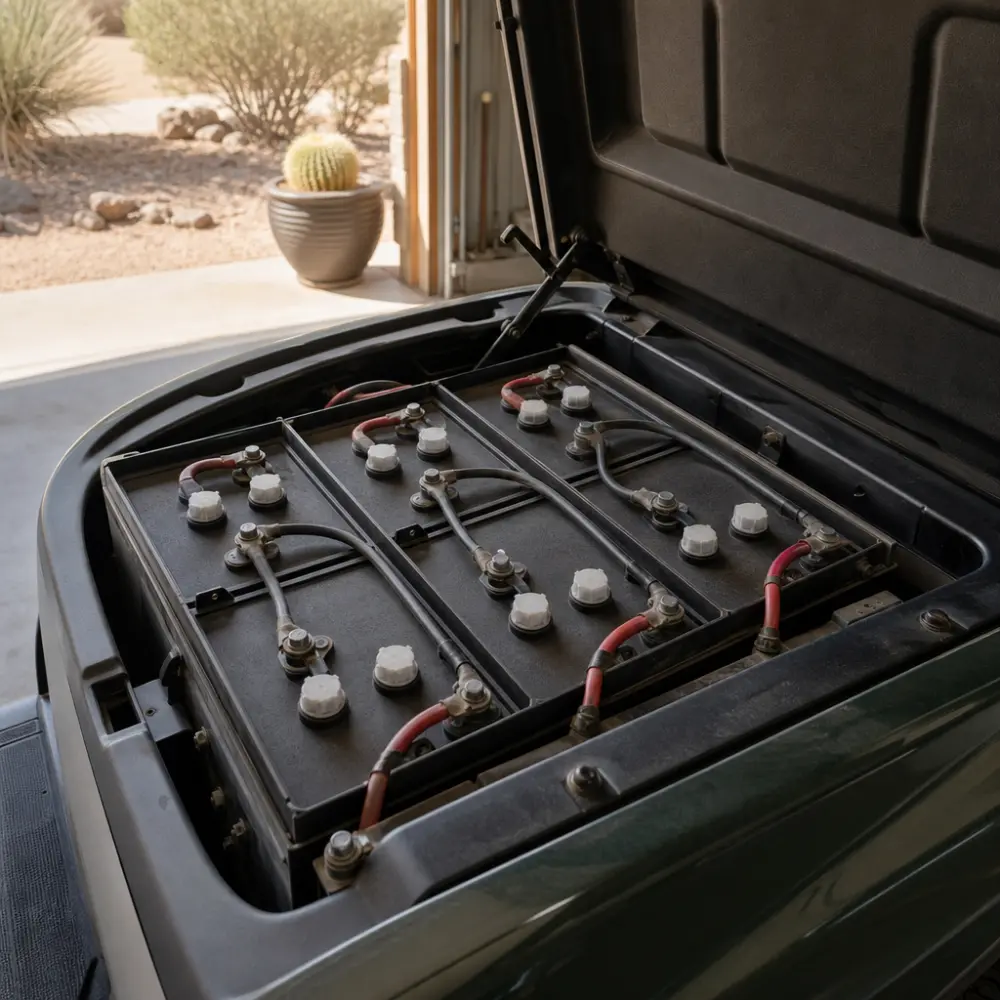
Oro Valley Golf Cart Repair sends a technician to your driveway, garage, or cart barn anywhere in Oro Valley and the surrounding Northwest Tucson foothills and fixes your cart on-site: batteries, brakes, tires, chargers, solenoids, motors, controllers, and lights. A full lead-acid battery pack runs $1,200 to $1,800 installed, brake work $75 to $400, tires $75 to $150 each, and the $50 to $100 service call is applied toward your repair. Describe the symptom by form and we usually arrive with the likely parts already on the truck.
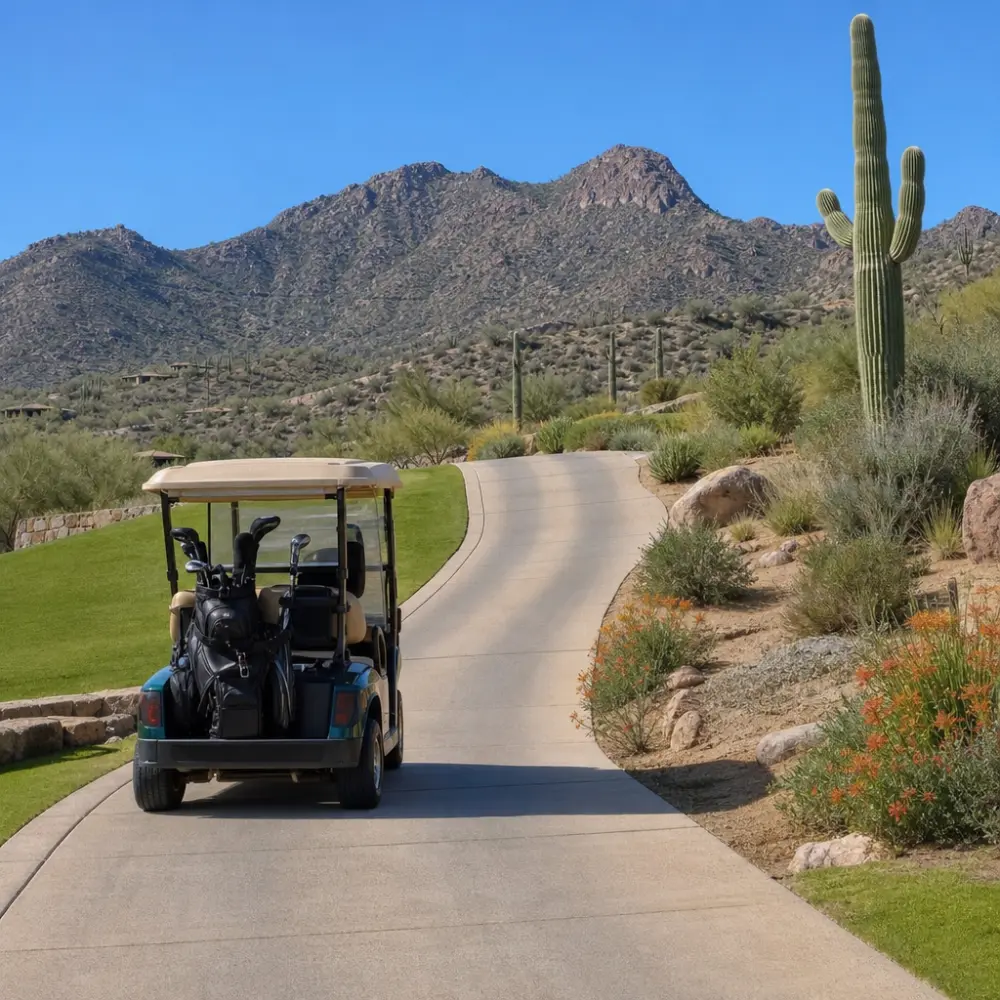
Oro Valley is a golf cart town because it is a golf community town. The Town of Oro Valley was incorporated in 1974 and counted 47,070 residents at the 2020 Census, and the ground it sits on explains why the carts here work harder than a flat retirement grid: Oro Valley occupies the middle stretch of the Cañada del Oro valley, and its eastern side rises sharply toward the Santa Catalina Mountains, whose Pusch Ridge tops out at 5,366 feet on the way to a 9,157-foot summit, while the western side climbs more gradually to the foothills of the Tortolita Mountains. A cart that lives on that terrain, or in a golf course community built into it, sees real grades every day, not the flat cart-path loop most of the industry writes its brake specs for. That is the difference this site is built around.
What we fix, at your home
- Mobile golf cart repair: the core service. On-site diagnosis and repair of whatever is wrong: will not move, will not charge, weak going uphill, clicking, cutting out. All major brands, electric and gas.
- Battery replacement: new lead-acid packs installed with haul-away of the old cores, plus honest lead-acid versus lithium math for carts that climb real grades every day.
- Brakes and tires: adjustments, shoes, drums, and new tires installed in your driveway. A cart parked on a slope in SaddleBrooke or the Catalina Foothills wears brakes on a different clock than one parked flat.
- Motor and controller repair: solenoids, speed controllers, and drive motors diagnosed with meters before anything gets replaced. Controllers and motors work harder pulling a loaded cart up a real hill, and it shows up as heat-related failures here more than in flat markets.
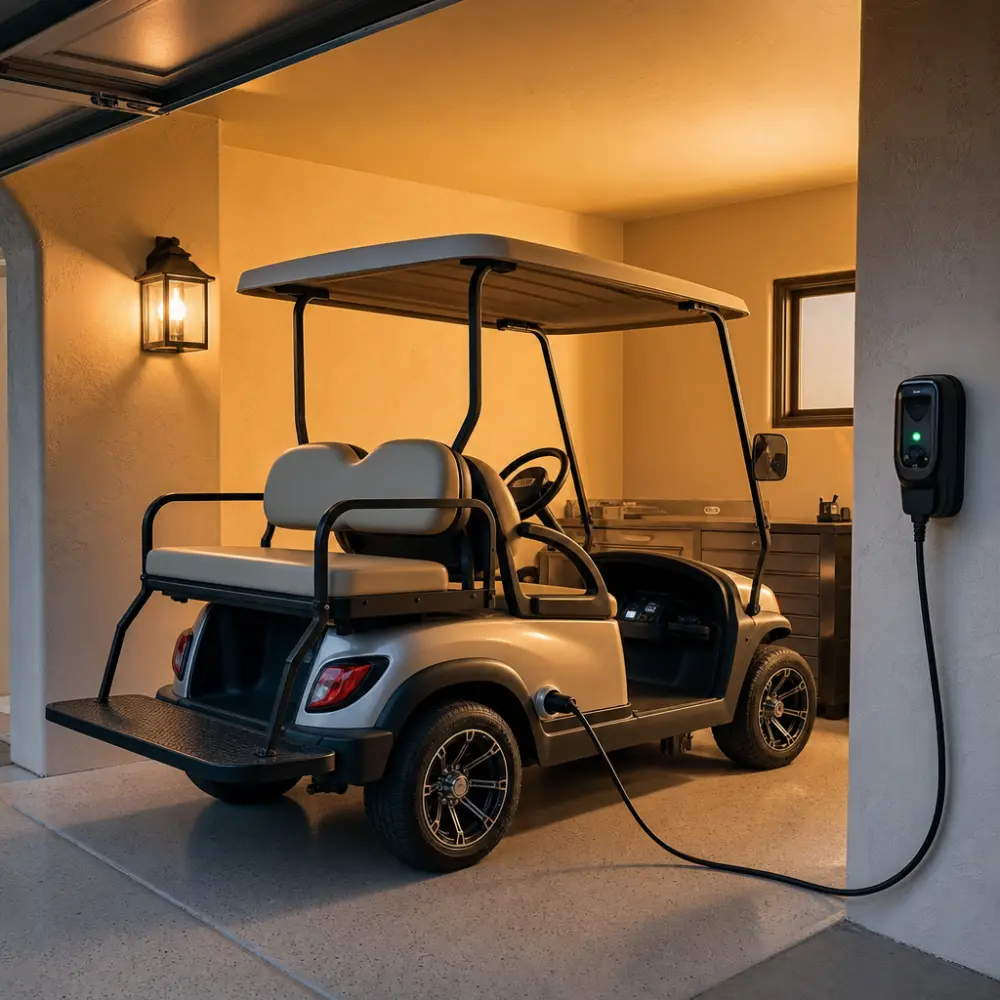
- Charger repair: carts that “will not take a charge” are often a charger, charge port, or corroded connection, not a battery problem. We test before we sell you anything.
- Tune-up service: the Northwest Tucson annual: battery water and load test, terminal cleaning, brakes, tires, lights, and a corrosion check that matters more after five months of desert dust and monsoon runoff.
- Lights and street-legal equipment: headlights, brake lights, signals, mirrors, and reflectors installed to what Arizona’s golf cart and neighborhood electric vehicle statutes actually require.
Full ranges for everything are published on the pricing page. Competitors make you call for a number. We would rather you see it first.
Why Oro Valley-area carts break the way they do
Heat is the battery killer, and it runs longer here than most owners expect. NOAA’s 1991 to 2020 normals for Tucson International Airport put the annual average high at 84.0°F, with June averaging 101.2°F, July 100.2°F, and August 98.6°F, and the station counts 157.8 days a year at 90°F or above and 67.9 days at 100°F or above. Inside a flooded lead-acid battery, heat evaporates water out of the electrolyte faster, and once the level drops below the top of the plates, the exposed lead sulfates and permanently loses capacity. Heat also raises self-discharge, so a cart that sits closed up in a garage in July comes back lower than it left. Oro Valley itself sits a few hundred feet higher than the airport and runs slightly cooler, but the pattern is the same: watering on a schedule from May through September is the cheapest thing you can do for a $1,200 pack.
Monsoon season adds humidity and dust in one short burst. The same Tucson normals put June through August precipitation at 4.42 inches, more than 40 percent of the year’s 10.61-inch total, nearly all of it arriving as sudden monsoon storms rather than steady rain. Garages that stay bone dry ten months of the year get a hard humidity spike in July and August, and blowing dust ahead of a storm works into terminals, brake drums, and switch contacts. A charge port or terminal that corrodes in a two-week monsoon burst can mimic a dying battery pack, which is why a voltage-drop check along the main cables is part of every diagnostic here.
Grades are the variable a flat-market price list does not account for. A cart working the slopes of SaddleBrooke or the Catalina Foothills, or making the climb into Dove Mountain where the community spans elevations from about 2,300 feet up to 4,300 feet in the Tortolita Mountains, draws more current on the way up and asks more of the brakes on the way down than a cart on a flat retirement grid ever does. Controllers run hotter, motors work harder, and brake shoes and cables need checking on a shorter interval. We size the diagnostic to the terrain the cart actually lives on.
Golf cart or neighborhood electric vehicle: what Arizona actually allows
Arizona defines a golf cart under A.R.S. § 28-101(38) as a vehicle with at least three wheels, an unladen weight under 1,800 pounds, a top speed of no more than 25 mph, and room for no more than four people including the driver. A neighborhood electric vehicle under § 28-101(56) is a different, stricter category: it must be emission-free (electric), have at least four wheels, and meet the federal low-speed vehicle equipment standard in 49 CFR §§ 571.3(b) and 571.500, which means headlamps, stop lamps, turn signals, taillamps, reflectors, a parking brake, mirrors, a windshield, seat belts, and a VIN.
Only an NEV built or equipped to that standard has a clear statewide right to use ordinary streets: § 28-966 caps it at 25 mph and keeps it off any highway posted above 35 mph, though it may cross one at an intersection. A bare golf cart that has not been built out to that equipment list has no equivalent statewide street right; § 28-2153(D)(7) only exempts it from registration when it is used on a golf course or incidentally moved across a highway. There is one narrow shoulder allowance in § 28-721(C), the rule that lets Sun City-style Maricopa County communities put carts on a paved shoulder, but it applies only to an age-restricted community in the unincorporated part of a county with more than three million people. Pima County’s 2020 Census population was 1,043,433 and Pinal County’s was 425,264, both far under that line, so that shoulder allowance does not reach Oro Valley, SaddleBrooke, or any community on this site. The full picture, with the Oro Valley Town Code section that governs it, is on our street-legal rules page.
Where the carts live
SaddleBrooke and SaddleBrooke Ranch, just north of Oro Valley along Oracle Road, are the anchor of cart demand up here: a 55-plus Robson Communities development with roughly 5,400 homes planned across SaddleBrooke One and Two plus SaddleBrooke Ranch, and 36 holes of golf between the Preserve and MountainView courses. Rancho Vistoso is the master-planned district inside Oro Valley itself, built out under a Planned Area Development adopted in 1987, and includes Sun City Oro Valley, a Del Webb 55-plus neighborhood of just under 2,500 homes built from 1987 to 1995 around its own golf course. Catalina sits between Oro Valley and SaddleBrooke along the same Oracle Road corridor. Catalina Foothills and Casas Adobes are the established, larger CDPs south of Oro Valley toward Tucson. Marana and its Dove Mountain golf district sit west across the Tortolita Mountains, where the terrain is the steepest we service.
How a mobile visit works
- Tell us the symptom. Will not move, clicks but no go, will not charge, sags on the climb home, squeals when braking on a slope. Most problems narrow down fast from a good description, so the tech arrives with the likely parts.
- We come to you. Driveway, garage, or cart barn, at a scheduled window. The $50 to $100 trip fee includes the diagnostic and gets applied to the repair.
- We diagnose before we recommend. Load test on each battery, voltage checks across the pack, charger output test, voltage drop along the main cables, solenoid and controller checks. We isolate the actual fault instead of selling the most expensive maybe.
- Flat quote on the spot, fix on the spot. Battery sets, solenoids, brake shoes, and tires are usually on the truck. Approve the number and most jobs are done in that same visit.
- Finish clean. Lead-acid packs get watered and terminals cleaned and coated, everything gets a torque check and a test drive on the actual grade the cart lives on, and old batteries leave with us for recycling.
Straight answers, published prices
Two things we will not do. We will not pretend to be something we are not: we are an independent service, not an authorized dealer or warranty center for Club Car, E-Z-GO, Yamaha, ICON, or Evolution. If your cart is under factory warranty, your selling dealer should handle warranty work. And we will not sell parts you do not need. A cart that will not charge gets a charger and charge-port test before anyone talks about a battery pack, and a weak cart gets a per-battery load test before we condemn six batteries when one is the problem. If a repair does not make sense against the value of an old cart, we will say that too.
The work is done by experienced, insured local golf cart technicians. More on how we operate is on the about page, and the FAQ answers the questions we hear most.
Get a fast quote
A lot of owners land here after typing “golf cart repair near me” with a cart that will not leave the garage. That is exactly the call this service was built for. Tell us the brand, model year if you know it, whether it is a 36V or 48V electric or a gas cart, and what it is doing. A photo of the battery compartment or dash helps. We will come back fast with a flat number and a scheduling window, and in most cases we can reach you same-day or next-day anywhere from the SaddleBrooke gates to Rancho Vistoso to Dove Mountain.